
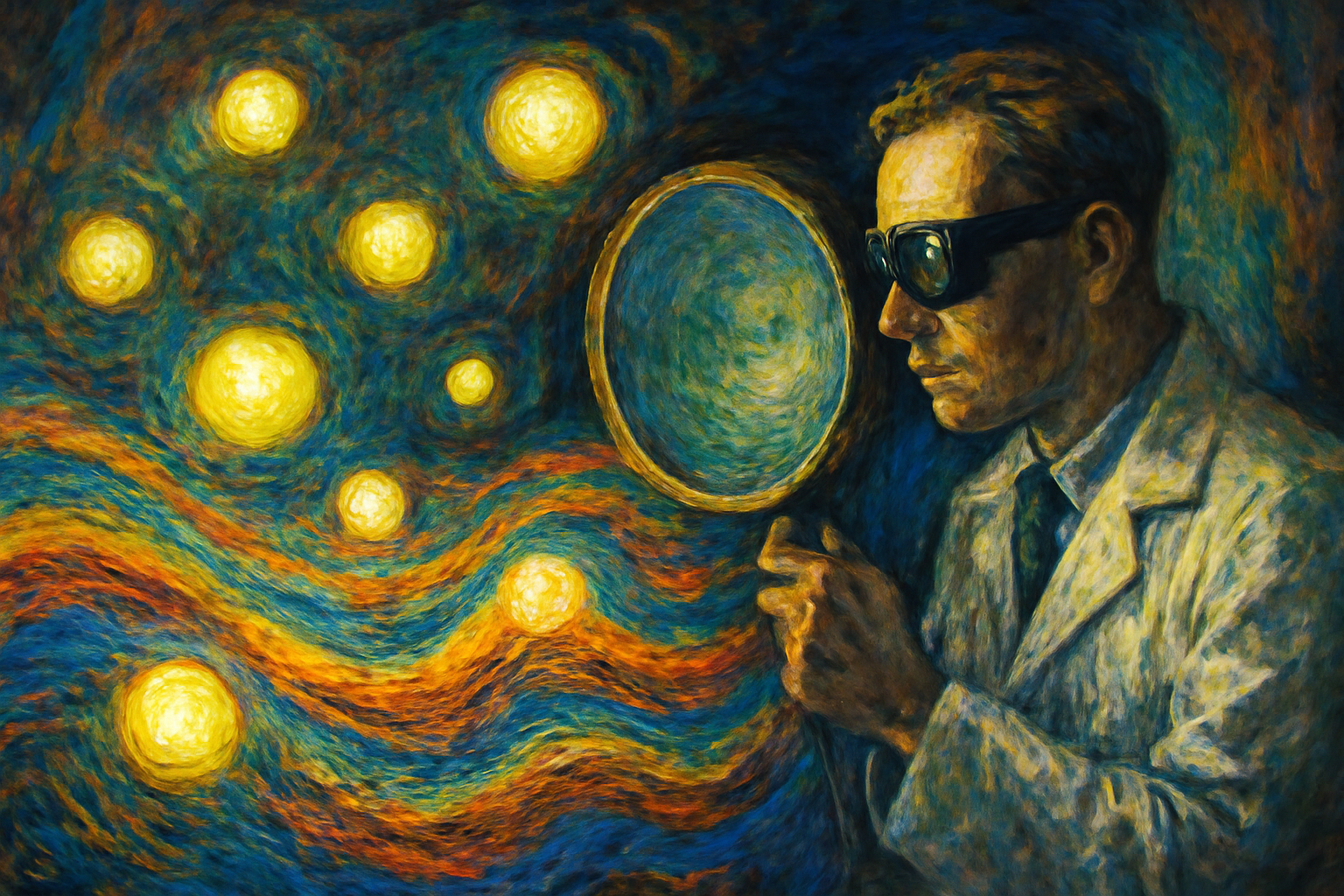
In the realm of quantum mechanics, the act of observation affects the phenomena being observed. This concept is notably illustrated by what happens when we observe photons, the elementary particles of light.
Photons exhibit both wave-like and particle-like properties, a duality central to quantum theory. This is famously demonstrated in the double-slit experiment. When unobserved, photons can pass through two slits simultaneously, displaying an interference pattern typical of waves on a detection screen behind the slits. However, if a measurement device is used to observe which slit the photon passes through, the interference pattern vanishes, indicating that the photon behaves as a particle, going through one slit or the other. This change is not due to any mechanical impact of the measurement process but is intrinsic to the nature of quantum systems.
This phenomenon is rooted in the principle of quantum superposition and wave function collapse. When not observed, a photon exists in a superposition of all its potential states, which in the case of the double-slit experiment, includes going through both slits at once. Observation instigates the collapse of the superposition to a single state—one that aligns with the observed attribute (particle-like behavior).
Such behaviors exemplify fundamental ideas in quantum mechanics, including the observer effect and the probabilistic nature of quantum states. Observation not only highlights different aspects of a quantum system but actually influences its state, thereby reinforcing the peculiar and non-intuitive aspects of quantum theory.